Friday, February 28, 2014

A New Year: Three New Employees
by Laura


Here at Field & Forest Products each new year brings forth great ideas. Last year we had many including revamping our packing room, designing Field & Forest stickers to include in orders, purchasing a new more energy efficient walk-in cooler, and reconfiguring the employees and their office spaces. The later, seems to have left me all alone (except during the lunch hour when the production workers want to peruse the internet.), but this gives me a great opportunity to contemplate and create epic blogs for all to enjoy. See, we have two main office spaces here, Corporate and the Annex. When walking through the front door of Field & Forest you are immediately entering the Annex. There you will find my smiling face. I do share this space with Jasen so I am not truly alone, but he spends just about all of his time making spawn just to the North of me. If I look to the West I can see into Corporate, which houses all of the other VIPS of F&FP. To the East is the packing room. So why the sudden change up of whom gets what office space? The answer is simple...new employees.
We have a total of three new staffers this year. We were in serious need of help in the packing room as well as the lab. It seems that growing mushrooms is becoming more and more popular, which benefits us, as well as you, and perhaps the rest of the world. As sales increase so do the number of orders we send out each year, and the amount of spawn that must be produced and maintained. Our kind of business requires a great deal of collaboration, teamwork, and good food! With all of that said F&FP is proud to introduce Chance, Derek, and Jon.


Chance

 
I am 17 and live in Marinette, Wisconsin. Currently, I am a junior enrolled in Marinette High School, but go through a schooling program called GPS Education Partners, which offers students the ability to take more of a hands-on approach to education by partnering with area businesses to provide work experience. Prior to working with Field & Forest, I didn't know anything about mushrooms or the business.  Since October, when I first became employed, I've learned how to inoculate logs, grow mushrooms, and now know when mushrooms are ready to harvest and how to pick and grade them for shipping. I've also learned about packing and shipping orders. Overall, working here has taught me how to be a good employee.

Outside of school and work I like playing video games, playing rugby and welding. I'm still undecided about what my goals are for after graduation in the spring of 2015.

Derek



I would best describe myself as an outdoor enthusiast who is an extremely devoted Packer fan. Currently living in Titletown, USA and proud to be a new member of the Field & Forest Products team; I started working for the company in January of 2014 after receiving my Bachelor’s Degree in Biology from the University of Wisconsin Green Bay.
During the week you can find me processing orders and packaging them in a secure and orderly fashion. I also help out with a variety of activities that go along with mushroom production. On the weekends you can find me exploring the Bay and small inland lakes for fish and waterfowl or in the northern woods of Wisconsin hunting deer.

Jon


I have had an interest in mushrooms for about as long as I can remember. Even now one of my favorite activities is hunting for edible mushrooms in the spring and fall. Although I grew up in Vermont my interest in fungi keeps bringing me back to Wisconsin; first as a graduate student in mycology at the University of Wisconsin-La Crosse and now as a production and research mycologist for FFP. I am excited to be working at F&FP in a capacity that will allow me to follow my passion for edible mushrooms and their use in agricultural systems.

Tuesday, February 11, 2014

The New Small Farm: Cultivating Encouragement for the Future 
by Mary Ellen

Polyculture work with Almond portobello and tomatoes‏.

Earlier this month we attended the 15th Annual Michigan Small Farm Conference at the top of the mitten in Traverse City. The day-long event registered a record number of attendees, a thousand or more. It was impossible to miss the prevalence of young farmers in the mix.  You can’t imagine how exciting it is for us “old timers” to see the small farm interest busting out with young, articulate, motivated people who are not only interested in land stewardship, but who are operating CSA’s and Market Gardens; already sharp farm managers. Lucky for cooks, mushrooms are part of the crop mix!

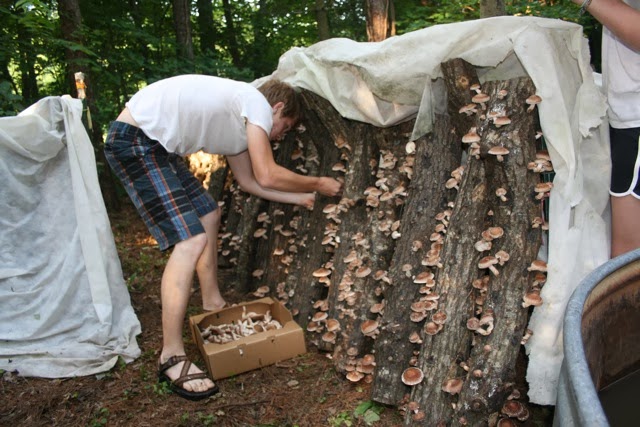
Mushroom grower at Ozark Forest efficiently picking Shiitake with the double handed harvesting method‏.

The Keynote speaker, John Ikerd, Professor emeritus of Agricultural Economics at University of Missouri and a long time observer of farm sustainability, contributed some interesting observations and a convincing pitch for the viability of the small farm. He says, “Small farms of the future will be different from those of the past. They will utilize new knowledge, technologies, and market opportunities to become even better farms than before.”

Encouragingly, the emerging attitude amongst many of these young farmers is that it’s best to be driven by ethics, not economics.  John Ikerd elaborated on this idea. “A real farm is not just an economic enterprise; it is also a way of life and a sacred trust. It’s not just about production and profits; it’s about meeting the real needs of real people, all people, both today and in the future. Real farmers care about their families, they care about the land, they care about their neighbors, they care about their customers, they care about society, and the future of humanity. A new renaissance and reversal of trends is emerging in the search for real food from real farms, and the real farms of the future will be appropriately small.”

The argument is not necessarily about the validity of “large farm” vs. “small farm.” The industrialization of agriculture over the last 50 years has played a large hand in cheaply feeding our growing world and providing us with food choices our grandparents could never have imagined. Though extremely difficult to evaluate, the real cost of degradation to our natural systems and subsequent biological and social effects on human society is increasingly influencing  peoples’ food choices and subsequent growing support of the new small farm.

The way we see it, growing mushrooms is a way of adding value to a farming system that embraces the entire ecological cycle of harvest and decay.  At Field and Forest Products, we are indeed “proud to be part of this rotting world,” and we are also very proud to be part of this exciting shift in agriculture and the people who are driving it.

For the transcript of John Ikerd’s keynote, go to:http://mismallfarmconf.files.wordpress.com/2014/02/john-ikerd-small-farms-are-real-farms.pdf

Tuesday, July 16, 2013


Oyster Mushroom Meets Grill
Written by Mary Ellen
 
Three Oyster Mushroom Wrap with the works!

Here in Northeast Wisconsin a party ain’t a party unless you have “three meats.”  Usually that means pork, chicken and beef (there are no such expectations about any vegetables) so here at F&FP we sure would like to see Oyster mushrooms  take at least one of those spots.  

A no-fuss  ‘Three Oyster Mushroom Wrap” makes a fast and delicious meal. No need to worry about marinades or BBQ sauce, plus how about those vegetarians in the crowd? This wrap will satisfy everyone, even mushroom haters. We guarantee it!  
 
Rachel reveals the three types of Oyster mushrooms (Pink, Golden, and Grey Dove) that will serve as the filling for her birthday party wraps.
All you need is a grill pan (this is one of those pans riddled with holes that will give the food a nice smoky flavor). Ingredients…a mess of Oyster mushrooms and optionally an assortment of chopped vegetables. Use what is lurking in your vegetable crisper if you don’t have an ethnic direction with this dish.  

Method: Get the grill heating. Take your Oyster mushrooms and trim away any straw or bits of wood. From the base of the stem, rip the Oyster mushroom upward until you have a pile of thickly shredded of mushrooms. They cook down fast so you can rip the mushroom into quarters or even leave them whole if they are small.  

Chop a sweet or red onion into chunks. Chop any other vegetables. We like zucchini and sweet peppers. Get a large bowl and toss everything together. Drizzle some vegetable oil on top and toss it all together with your hands until everything is lightly coated with oil. Sprinkle liberally with coarse salt.  

The Oyster mushrooms have been torn into pieces, and the veggies are all cut up, now it's time to grill.

Now have fun with the seasonings!  If you are having a Mexican style wrap, sprinkle with cumin and smoked chipotle chili or smoked paprika. Indian wrap? Cumin and coriander or a zillion other spice combos. New artisanal tortillas inspire a dozen  filling themes, and before you know it you will be adding pineapple, or pears and gorgonzola…maybe even BBQ sauce! Toss until everything is evenly coated. 

Now, slide everything into your grill pan and casually stir fry with a spatula until done (depending if you like crispy or soft) and take advantage of the waning grill heat and warm up your tortillas. Heap on to a serving platter and surround it with condiments: sour cream, cheese, lettuce, salsa, chutney; whatever you have on hand that fits the theme.  

This dish takes less than 30 minutes to assemble from kitchen to table (not including heating up grill; if you live in Northeast Wisconsin sometimes that means heating it with firewood). It is really and truly one of our favorite summer dishes.  If you try it, let us know if you have a favorite flavor combo. Thanks!

Wednesday, March 20, 2013

The Italian Love Affair
Written by Mary Ellen


The Italian Oyster is a delight in both the kitchen and the grow room.

What is the big whoop about Italy and food? Forget the Gelato. The whoop is really all about the Italian Oyster Mushroom. Forget also that the name probably has nothing to do with Italy (besides the name). This is a big complex of Oyster mushrooms with a very wide geographical range. What we do know is that they are a wonderful species of Pleurotus; they are beautiful, tender, creamy brown and white, succulent and the closest culinary match to the glorious King Oyster, and they are a lot easier to grow. Known to mycologists as Pleurotus pulmonarius, the Italian Oyster (Indian Oyster, Chocolate Oyster or Phoenix Oyster, etc.) may have lots of variations within its group, but all share some characteristics that are important to both cultivators and cooks.

In my case, I have been grateful for the forgiving nature of the Italian Oyster, which we grow indoors on pasteurized straw, all winter long. This species seems less sensitive to the effects of light on fruitbody formation, and at the 45th parallel, although we need supplemental light, we don’t always arrange for it. Perhaps it is just not as noticeable because of the shape: short thick stem and spatula or lung shaped caps (hence the species name pulmonarius)* and much less inclined to become overly cupped, clustered and long stemmed as the Tree Oyster group. While it is considered a warm weather Oyster (compared to the P. ostreatus group such as Grey Dove, Blue Dolphin and Polar White strains), it also handles a 58 degree (F) fruiting room just fine.


Italian Oyster fruiting from a straw bag in the grow room at F&FP.

While first crops of the Italian are robust and large capped, subsequent flushes are smaller and can be harvested very young as “Petite Italiana.” A handful of these sweet Petites are tender, juicy and pure delight to use in the kitchen. Even a small grow room can house a few bags of these Oysters, which will produce many months worth of special meals.

One of my favorite ways to use these mushrooms is to braise them; split each in half or in quarters and then caramelize one side in butter, letting them braise in the released juices with a dash of fresh lemon juice or white wine. I treated myself to such a dish the other day in celebration of more snow and the promise of a long, slow spring, nourishment for our thirsty soil following last year's drought. 

Braised Petite Italiana with Snow Peas


Braised Petite Italiana with Snow Peas sets the mood for spring.
 
 
Ingredients:
1 pkg. snow peas, rinsed and unstrung (6 oz.)

4 oz. small Italian Oysters, including stems, split in half (start the split from cap side)
2 tsp. butter
1 T. fresh Lemon juice
Salt and freshly ground pepper
1 tsp. oil

In a medium saucepan, heat 2 tsp butter and add torn caps, Let the pan side caps sizzle for about 2 minutes until they become caramely brown. Sprinkle liberally with coarse salt and fresh pepper, stir and put the lid on. A minute or so later, add 1 T of lemon juice, replace lid and cook until tender. 

Remove the mushrooms and set aside. Add 1 tsp oil and add the snow peas, stir frying briefly until tender. Plate the peas and top with a liberal scoop of mushrooms. Happy Spring!


*Kuo, M. (2009, April). Pleurotus pulmonarius: The summer oyster. Retrieved from the MushroomExpert.Com website: http://www.mushroomexpert.com/pleurotus_pulmonarius.html

Wednesday, February 20, 2013


Shipping Charges Explained...
...Well, Kind of
Written by Joe

This young man might like to know the reasons behind shipping costs.

One of the most commonly asked questions by our customers is “why are shipping rates so high?” This often happens right after the first of each new year. I’ll try my best to explain shipping charges in this post.
All of our spawn products are heavy, wet, and wood or grain based. We also ship wax, another dense heavy object. As you may already know, shipping this kind of product can be expensive.
Field and Forest Products is marking its 30th year in business, and for each of these years there has been an average price increase of 5% by our major carrier, UPS. While 5% may not seem like much, one has to bear in mind that the key word here is “average.” In general, lightweight packages weighing less than 30 lbs. saw an increase of 7.5%, whereas packages weighing upwards of 75 lbs. saw a price increase of only 1.69%! On top of the overall price increase, package surcharge fees also went up. For instance, delivery to a residential address (this includes all you farmers out there) adds another $2.80 to the standard delivery charge. Add to that an extended delivery surcharge to certain zip codes and the surcharge jumps to $3.30.
When placing an order, one thing to remember is that “bundling” of spawn orders reduces the cost per bag to ship. For instance, shipping one 5.5 lb. unit of sawdust spawn to a zone 5 residential address would cost $15.28. Adding an additional 5.5 lb. unit would only add an additional $1.19 to the shipping charge, thus bringing down the cost per unit to ship. The bottom line: try to get all your spawn ordered and shipped in one box (or maximize each box for larger orders requiring multiple boxes) if possible. How much spawn will fit in a UPS box? As a general rule, a UPS box can hold up to: 8 large bags of sawdust spawn; 12 large bags of grain spawn; 12 large bags of plug spawn; or 15 sheets of thimble spawn. The only bundling we cannot offer is that of seasonal spawn ordered out of season. This would include Almond Agaricus, Pink Oyster, Morel, and Portabella or White Button box kits.
On the upside, UPS guarantees time in transit and their software allows us to send our customers an email notification when their order ships, providing them with accessible tracking information. Field and Forest Products also has negotiated rates with UPS. We pass the discounted price on to our customers. For orders weighing over 200 lbs., we are a UPS tier 1 shipper, qualifying our large shipments for the largest discount UPS allows, which is about 10% over our negotiated rates.
What is Field and Forest Products doing to keep shipping costs to a minimum?

In order to keep shipping charges to a minimum for our customers, we seek out alternative carriers for customer shipments and use them whenever possible, passing along the savings. When placing an order online it appears as if UPS is the only shipping option, BUT this is not always the case! Due to the variety of shipping options available to us, we manually calculate shipping charges on all online and phone orders to determine the best shipping option available so that we may provide our customers with the best rate and delivery time possible. Savings, when using an alternate carrier, are directly reflected on your invoice. With the myriad of shipping options available to us, it would be difficult to program our website to accurately calculate which combination of items would fit in a particularly box size, etc., and then select the best possible option. Placing all of those options on our website would most likely confuse our customers as well. This “customized” approach is somewhat unique in the mail order world, as it takes extra resources in staff and packaging supplies, but it makes us feel good to try to reduce shipping costs to our customers whenever possible.
Jeni packing an order into one of our USPS priority boxes, an option for smaller orders!
Other Carrier Options

In the Midwest, we are fortunate to have an alternative carrier, Spee-Dee Delivery Service, whose costs to transport packages is around 50% lower than standard ground charges by the two nationwide carriers. We use SpeeDee Delivery Service for package shipments to all addresses in Wisconsin, Illinois, Minnesota, Iowa, North Dakota, South Dakota, eastern Nebraska and zip code areas 630, 631 and 633 in Missouri. The only downside to using Spee-Dee Delivery Service is that their software is unable to send email notifications to our customers to let them know that their package has been shipped.
Nationwide (including HI and AK), we ship orders of single large units of spawn and multiples of smaller unit sizes, as well as small tool and supply orders via the US Postal Service. The Postal Service in recent years has introduced additional packaging options with very competitive rates of flat rate and regional boxes, perfect for small businesses like ours. The downside to using the US Postal Service is that package delivery times are not guaranteed and there is no real-time tracking. We have noticed over the years, however, that the US Postal Service has upped its level of service and packages are more often than not delivered in 2-3 working days.

What you can do to help keep your shipping costs to a minimum:
•Order online or call for a shipping price quote, rather than placing an order by mail
•Bundle orders to ship all at once (or in quantities that will maximize the space in each box for larger orders when possible).
•Order over 200 lbs. of spawn and supplies :)
•Call to see if we can deliver your order to various conferences (posted on our website) that we attend. Please note that this option is “first come, first serve” based on vehicle space! 

If you would like a quote on shipping costs, we are always happy to accommodate your request. Please let us know if we can be of assistance. We can be reached at 1-800-792-6220 or via email, fieldandforest@centurytel.net

Monday, January 21, 2013


Spruce Up Shiitake and Make a Mushroom Streusel!
Written by Mary Ellen

A typical winter scene at F&FP
It’s winter and I recently staggered out the back door with our spruce tree turned tannenbaum as I feel I must do after Epiphany in January. The tree was still gorgeous and fully needled (at least on one side, coming from a crowded row of white spruce), but because we usually don’t get around to cutting our tree until a week before Christmas, I was sad to drag away the once dazzling, fragrant tree. I similarly feel sad (but also relieved) about the decline of wonderful holiday food. 
Our daughter Phoebe was home from college for the holidays and thanks to feed-yourself- apartment living, she has taken the great leap from cookie baking queen to vegetable diva. This is nice because while it's only January 15, I already start to feel the tedium of  post-holiday austerity, and I am thrilled to find Phoebe slice and crumble her way into a January meal with a Shiitake dish that is a little apart from the same old same old. It’s a new dish that I will be making whenever I want something a little special and healthy as a salad topping, a side dish or crunchiness to eat straight from the pan. I will always be satisfied with the memory of Shiitake Streusel making, a random winter night sparkling with creativity, accomplishment and mushroom cookery beautifully handed down to the next generation. 

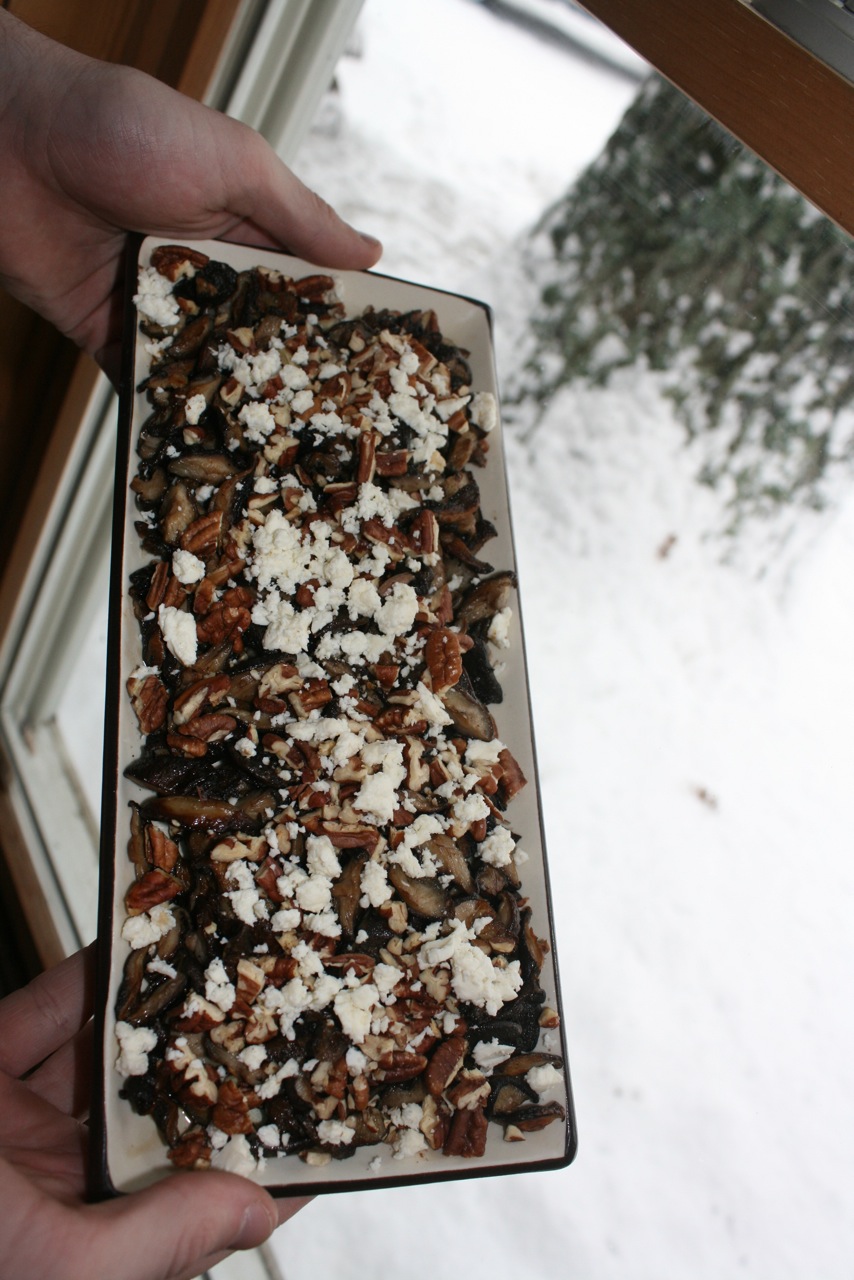
Phoebe's recent streusel creation.

Shiitake Streusel 

Phoebe’s apartment kitchen is minimally equipped, so all of her recipes are approximate. She gives us visual tips to let us know how much is enough. 

Ingredients:
1 to 1 ½ lbs fresh Shiitake
1- 2 T oil
Feta cheese, best quality - 4 oz. crumbled
1/4  to ½ c chopped toasted pecans or an amount to taste
Balsamic vinegar, about 1/2 to 1  T
A rimmed, oiled or parchment lined baking sheet

Preheat oven to 400 degrees (F)
Trim stems from Shiitake. Slice caps into ½ inch pieces.

In a large bowl, toss caps with the oil until the sides of the bowl and mushrooms are glossy. Season well with salt and pepper. Spread mushroom slices out in a single layer on the tray and put them in the hot oven,  turning the mushrooms with a spatula after the first 10 minutes. Let both sides approach golden brown and chewy.

Remove Shiitake and combine with cheese and pecans. Sprinkle with balsamic vinegar to taste. Serve warm or room temperature as a side dish, salad topping, steamed vegetable or casserole topping, wrap or omelet filling, etc.

Make these delicious buttermilk breakfast biscuits by brushing the tops with beaten egg and pressing shiitake streusel (substitute feta with smoked gouda) on top just before putting them in the oven.


Tuesday, December 11, 2012


Dried and Delicious
Written by Mary Ellen
 
Exquisitely prepared dried Shiitake in Japan.
Not everyone has an indoor grow room to produce plump, fresh shiitake mushrooms for the holidays (although you can come close with our TableTop Farms). If you grew your own on logs last summer and dehydrated the surplus, don’t forget that Shiitake (and other dried mushrooms) make great gifts, especially if you can provide the recipient with some easy cooking ideas!
 
First, not every delicious fresh mushroom makes an equally delicious dried mushroom, which is something to consider before you actually go through the work of drying them.  The essence of each species of mushroom in its dried form is often very different from the fresh. The first time I ate a dried Shiitake I recalled the taste of the pinch of pipe tobacco I snuck from my dad's Prince Albert canister as a kid. I couldn’t get past the different flavor; nothing like the garlicky, buttery flavor of fresh shiitake! However, several years ago Joe and I visited Japan during the height of fresh shiitake season and we were astounded to find ourselves eating various exquisite preparations of DRIED shiitake… and loving it!
 
Almost all mushrooms can be dried, but some are coveted in the dried form. Here is a respectable list:
 
Shiitake (Japanese forest mushroom, Chinese black mushroom, etc)
Woodears
King Bolete (cepes, porcini)
Netted Stinkhorn
Black Trumpet
 
If you have a mushroom to add to this list, please weigh in!
 
 
Give a gift of dried mushrooms this holiday season.
Here are some guidelines to follow if you are giving dried mushrooms as a gift:  

1.      Make sure the mushrooms are brittle dry. Sometimes they soften if not stored in an airtight container and are prone to molding. A plastic freezer bag or canning jar with a properly tightened canning lid will do the trick. If they are soft when you divvy them up for gifts, put them back in the dehydrator for an hour before re-packing.

2.      The “general directions for use” label might read: These mushrooms, grown with great labor of love, can be stored for months at room temperature as long as the storage container remains tightly closed.  For really long term storage, store in your freezer. To use: pour boiling water over the mushrooms in a bowl and let soak for 20 minutes. Strain the liquid and save as a broth.  Chop and sauté the mushrooms themselves (discarding the stem) and use as you would fresh mushrooms. 
 

Here are two very different recipes using dried shiitake (or the dried mushroom of your choice)
 
 
Simple Shiitake Sauce
 
This simple sauce might just knock your Christmas stockings right off!
 
This highly flavored sauce takes advantage of both the reconstituted shiitake and the resulting flavorful soaking liquid. Use it to sauce meats, fish, tofu or assertive vegetables such as cabbage or bok choy. Of course it’s also delicious on pasta.
 
1 c dried shiitake
1 c boiling water
¼ c chopped onion
1 clove garlic
½ tsp each sugar, soy sauce, salt
1 T flour
¼ c grated asiago or parmesan, optional
 
Pour boiling water over the dried mushrooms, soak for 20-30 min.  Meanwhile, sauté aromatics in 1 T butter. Add seasonings. Drain and strain the soak water from the mushrooms, saving the liquid. Slice the mushrooms, discarding the stem.  Add to the sauté pan and sprinkle with the flour, sautéing the whole bit for a few minutes. Slowly add the cream and soak water, cooking until the sauce reaches the consistency you like. Add cheese if desired.


Easy Spring Rolls with Shiitake
 
Refreshing spring rolls with dried Shiitake.
 
The body and soul often need a break from rich holiday food and festivities. These rolls are bright, crunchy, clean and can be so appreciated. If you’ve never made a spring roll do not hesitate to try this. The technique is useful and can be adapted to any fresh filling.
 
10-15 dried shiitake
10 or more round dried rice paper sheets
2 oz dried cellophane noodles
½ lb fresh bean sprouts
1 small cucumber, cut into match sticks
1 carrot, grated
4 T chopped peanuts
½ c chopped cilantro
 
Pour boiling water over the shiitake in a bowl and let sit for 20 minutes or more. Drain away the liquid (keeping for another use), squeeze the shiitake and blot with toweling to absorb the extra moisture. Thinly slice the shiitake, discarding the stem.
 
Pour boiling water over the cellophane noodles and let sit for 10 min. Drain and rinse with cold water.
 
Assemble all the vegetables, noodles and peanuts; have all the little bowls set in a line for easy filling.
 
Fill a cake pan with warm water and dip the rice sheets, one at a time, into the water  (make sure they are covered with water) to soften; 30-90 seconds. Lift out with tongs and set out flat on a dish towel.  Soften additional sheets as you work filling them.
 
Filling the sheets:
 
In the center of the softened rice sheet, layer the fillings (about 1/2 - 3/4 cup total) in a cigar shape in the center of the paper. Roll up the bottom, tuck in the sides and continue to roll to make a translucent, plump eggroll shape.  Cut in half and provide a dipping sauce.
 
Pineapple Dipping Sauce:
 
1 T rice wine vinegar
Juice from 1 lemon
Dab of chili oil or chili paste, or a red chili deseeded and thinly sliced
1 garlic clove, minced
4 oz crushed pineapple, canned with juice
 
Mix it all together and divide into beautiful little bowls or saucers for dipping.

Monday, November 19, 2012


The Inside Scoop: Field & Forest Products has a Baby
Written by Laura

Who here would have ever thought that bags of mushroom spawn would someday serve as bumper pads!
These days there are not too many businesses that will let you bring a newborn baby to work, especially in the way of agriculture. I’m here to tell you that babies can grow mushrooms too.
When I started this job nearly two years ago I had only two daughters ages 8 and 6. During my interview Mary Ellen had asked me if I had any concerns. I decided it best to tell her and Joe that I was a mom, and as most parents know, sometimes children need their moms during business hours. Joe and Mary Ellen, being involved parents themselves, knew where I was coming from, and told me there was flexibility with this job. I had no idea that almost two year later, flexibility would mean sitting side by side with my third daughter (only a month old) at my desk.
Sadie's favorite seat is right next to mom.
Some of you may have had the chance to talk with me here at F&FP…I answer phones, do design work on our website, enter orders, and many other clerical activities. However, I also make the thimble spawn, pack orders, pasteurize and inoculate straw, and many other not so clerical duties. I have no official job title, but I’m ok with that because it would probably have too many words in it anyway. I simply refer to myself as a cultivator. As a cultivator/mother I have to find ways to entertain a now three month old little girl on the mushroom farm. Her extremely laid back personality makes the challenges of working with her quite easy.
Luckily she is young, and naps often. Purchasing a mini swing to leave at the farm was a wise decision on my part. She spends a good 80% of her time in it. Babies are easily amused, and because of this she is often comforted by the steady hum of air coming from the ventilation fan in our incubation room. This room is also where orders are packed, and has a comfortable padded floor. She often just lays there stretched out enjoying the good life. The background noises here have conditioned my child to sleep through anything!  As I go through my daily routines I narrate to her the many workings of the farm. She is gaining the required knowledge to one day become a successful mushroom farmer.
Fast asleep on the packing room floor.
 
There are a total of seven of us here including Joe and Mary Ellen, baby Sadie makes eight. I never have to worry that no one will be there for her when I am busy. She is loved and appreciated here. I am positive that her treatment directly reflects the attitudes of both Joe and Mary Ellen. The environment they have created for the employees is second to none. We are privilaged because Field & Forest Products remains a small close-knit company. Hopefully all of this produces results that our customers feel as well. Working hard and showing respect, without taking advantage of all we are offered, allows for special benefits like bringing a baby to work.


Friday, October 26, 2012


Begging Rachel for Her Poor Man’s Pudding
Written by Mary Ellen
  
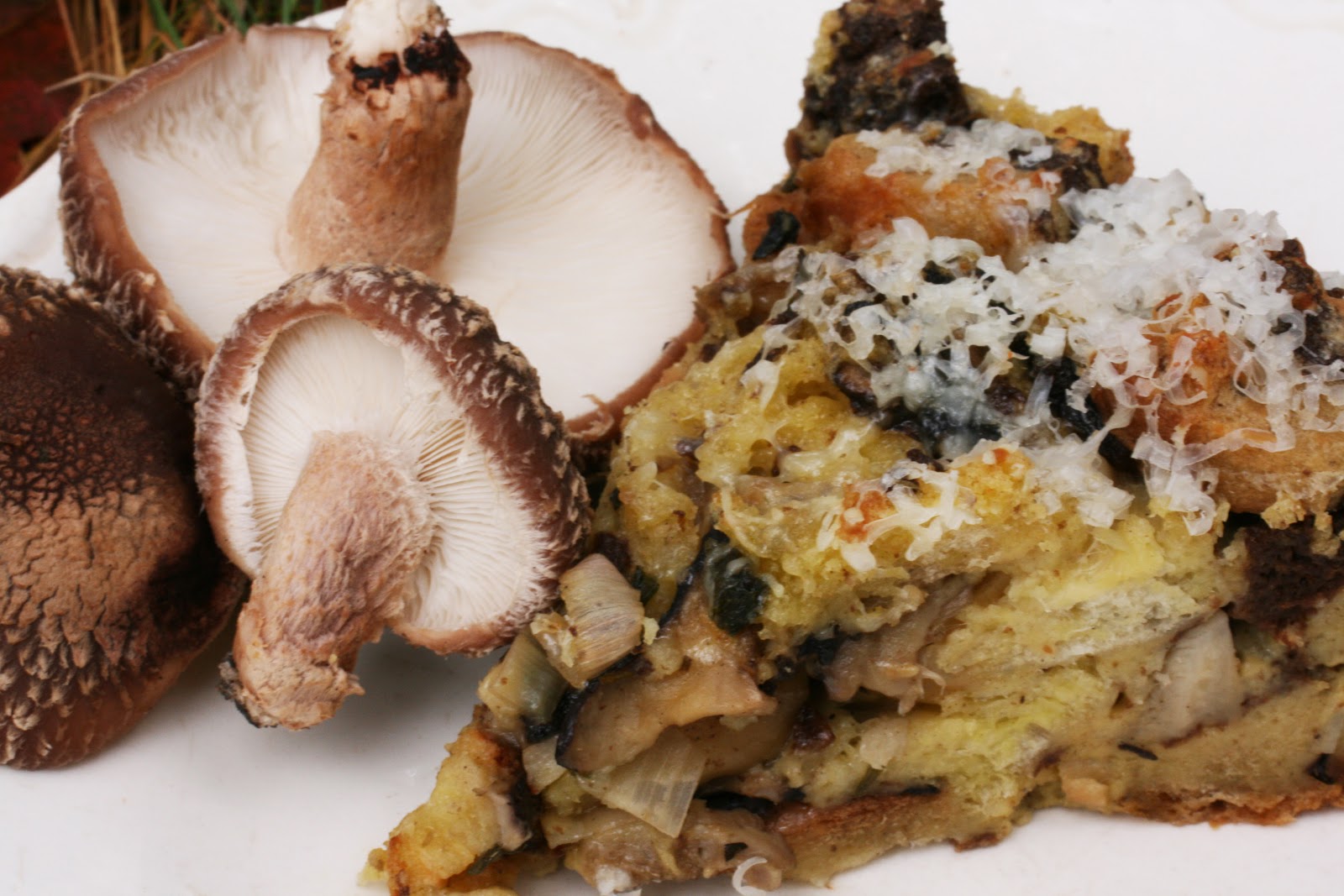
Shiitake Bread Pudding

Last year during fall shiitake harvest time, Rachel here at F&FP, experimented with mushroom bread puddings. There is nothing quite like great produce to inspire good cooks, and the fall shiitake have been nothing short of exceptional.

Recently, we remembered that day when she brought in last years creation, gorgeous and creamy, studded with mushrooms on a teal colored plate for Food Friday. We thought we’d make up a pan. Alas, the recipe was deleted from our blog, and like most good cooks she couldn’t remember the details of making it. She’s re-created the recipe for us and we thought we’d post it in case you missed it the first time around. Thank you Rachel!

Cold Weather Shiitake are fruiting here at F&FP, and man are they delicious. Miss Happiness is no exception.

A Note on “Bread Pudding”

Bread pudding was often called “Poor Man’s Pudding” for the obvious reason that it was made from stale bread. Nowadays a country cook still has thrift in mind, but also an eye toward delectability. Bread puddings are typically thought of as dessert, and take well to finely textured white breads, brioches and even bread crumbs. Savory bread puddings made with these are refined in character, but also can be glorious when made with sourdoughs, French breads and ryes…and Shiitake, as in this bread pudding!  

For the best bread puddings, whatever the bread, use one or two day old bread, thereby being slightly dry to soak up the liquids, but not so aged to taste stale.


Snow Cap: A beautifully ornamented Cold Weather.
 
 
Chocolov: A Cold Weather full of goodness. 

Shiitake Bread Pudding

6-7 C day old French bread or marble rye, cubed
About 1 lb. Shiitake mushrooms, sliced thin
1 small leek
3-4 cloves garlic
3 Tbsp extra-virgin olive oil
1 tsp thyme
1 tsp sage
1 tsp basil
Parsley and chives
5 eggs
2 C heavy whipping cream
1 C milk
¼ - ½ C parmesan cheese
Salt and pepper to taste

Heat the oil in a large skillet. Add garlic and leeks, sautéing until fragrant. Add the mushrooms and herbs, cook until mushrooms are tender, about 10 minutes. Add salt and pepper to taste.

In a large bowl, whisk together the eggs, cream milk, and parmesan. Toss in the bread cubes and let sit for 5-10 minutes. Gently mix in the mushrooms and pour into a buttered baking dish. Sprinkle with parmesan and bake at 350 for 45 minutes to an hour.

------------------------------------------------------------------------------------- 

If the bread pudding is a little dry (a lot depends on the density and moisture of the bread) you can serve it up with a side of Whipped Cream Horseradish Sauce. Come to think of it, whip up a side anyway, you won't regret it.

Whipped Cream Horseradish Sauce

1 c whipping cream
1 T prepared, jarred horseradish
1/4 tsp pepper

Sugar to taste

Whip up the cream to soft peaks and whip in the horseradish and pepper.  Eat immediately :)


Bellwether: F&FP's newest Cold Weather Strain.


Thursday, September 20, 2012

Falling for Autumn Shiitake
Written by Mary Ellen
Flashback: Joe and Phoebe (and Merlin) enjoying the fall Shiitake harvest.
Joe tells us that the only time he was ever taken out of school was when the podpinki (buttons/stumpers/honey mushroom/Armellaria
mellea) were in season. He, his dad and grandfather would go cut banana boxes full of podpinki and jam them into the back of the family station wagon.  They’d arrive home as if fresh off a bank heist! His mom would be faced with hours of cleaning and canning mushrooms (isn’t it much more fun to be the forager than the kitchen drudge?).  This might be the reason that spring is her favorite time of year.
Here is an Armellaria species, just one of at least a dozen very similar species grouped together and labeled by mushroom hunters as "Honey Mushrooms," or as in Joe's example above, "podpinki." Do you have any tales about picking Armellaria? If so let us know in the comments section below.

Armellaria infrequently fruit on shiitake logs but ...even so, you should know what they are in case they make a showing! Identifiers: often clustered, growing in fall on wood, buff/brownish/yellow, often sticky caps with a bristling of short "hairs" on the top of the cap. Gills are attached, cream colored, and covered with a fibrous or webby "skirt" which becomes the ring on the stem as the mushroom grows. Spore print white.

There is no need to go foraging beyond your backyard if you are growing shiitake mushrooms. Yes, this is IT…Shiitake time! Shiitake have two general fruiting times when there is almost nothing you can do to stop the fruiting impulse…Fall, and (to a lesser degree), Spring. Planting a mix of different strains will help stretch out the season, but the combination of temperature change, rainfall and humidity after a long hot summer can mean grocery sacks full of mushrooms. 
Autumn: Flying geese, falling leaves, apple cider, wood fires...mushrooms!
 On our farm, we finished up a week or so ago with a nice natural flush of mushrooms from logs planted with Wide Range strains. Now the logs planted with Warm Weather strains, especially WW70, (a vigorous fall fruiter), are bumpy with mushrooms. We had our first fall frost two nights ago so we await with pleasure the prospect of harvesting the gorgeous Cold Weather shiitake. 

WW70 is a star early fall fruiter.

Good shiitake fruiting goes hand and hand with rain, so we are often faced with black brown, water logged caps. Mushrooms like this have a much shorter shelf life than properly harvested shiitake, really no more than a week. Plus, their dark shiny appearance scares customers if the mushrooms are taken to market. It is best to avoid this problem by watching for the earliest stages of fruiting, and covering the pinning (baby mushrooms) logs with fruiting blanket, frost blanket or clear plastic until the mushrooms are ready to harvest. Even if you can cover the wet but still developing mushrooms a few days before the cap starts to pull away from the stipe (stem), they should develop beautifully for a high quality product at picking time.  

Sometimes you just can’t get the logs covered in time though. Water saturated mushrooms are just fine to eat unless they have developed a dark brown cast to the gills (meaning rot). Saturated mushrooms can be dried, but be careful not to overload drying trays. Monitor heat and air flow as these easily get past their prime before they fully dry. Our favorite way to preserve is to slice and sauté until the extra water releases and evaporates. Season the slices to taste and freeze pints or puree and pack into ice cube trays for later when the fine memories of the fall harvest are equal to the taste of fresh-frozen shiitake. 

Pine squirrels are just as likely to snack on football Sundays as are local cheeseheads. Covering fruiting logs helps reduce obvious bite marks in prime specimines.
Just now, after years of hearing the tales of podpinik hunting, Joe tells me that the underlying reason for going mushroom hunting was the side trip to the White River in Waushara County, WI…for fishing. Figures!

Go to our recipes page to try Rachel's wonderful Shiitake and Cheese Tart.